Gentle Mindful Meditation Infographic
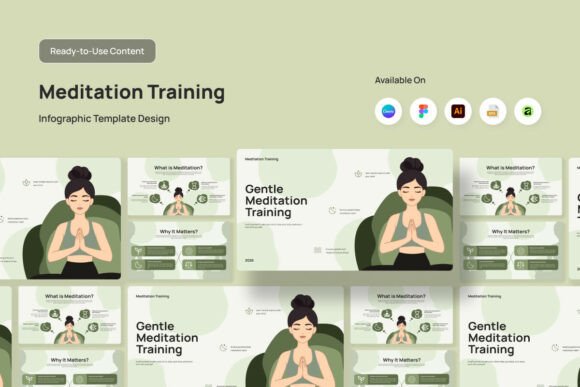
Mindfulness isn’t just a trend—it’s a foundational skill for resilience, clarity, and emotional balance. Yet translating its subtleties into accessible learning tools remains a challenge for many wellness professionals. That’s where the Gentle Mindful Meditation Infographic steps in: not as a standalone image, but as a thoughtfully crafted visual toolkit designed to bridge understanding and practice.
A Calm Bridge Between Concept and Practice
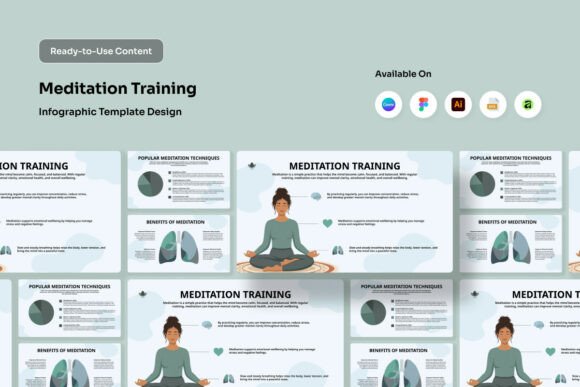
At its core, the Gentle Mindful Meditation Infographic is built on one principle: simplicity with depth. Each of its six design variations distills a distinct mindfulness pillar—like diaphragmatic breathing, body scan sequencing, or seated lotus alignment—into clean, flat-style illustrations. There are no distracting gradients or overwrought details. Instead, soft lines, balanced negative space, and intentional color palettes invite focus—not overwhelm.
This isn’t decorative art. It’s functional pedagogy made visible. For instance, one variation maps the 4-7-8 breath technique using numbered, circular nodes and gentle arrows—making timing intuitive at a glance. Another illustrates posture cues for mindful sitting with labeled anatomical anchors (spine, pelvis, shoulders), helping learners self-correct without verbal instruction.
Who Benefits—and How
The Gentle Mindful Meditation Infographic serves three primary audiences—but its utility ripples outward:
- Meditation instructors use it to reinforce verbal guidance during live sessions—or embed it into handouts that students revisit between classes.
- Health educators integrate it into workplace wellness programs, school SEL curricula, or clinical waiting-room displays—meeting learners where they are, visually and emotionally.
- Creative leads and content strategists rely on it to maintain brand-aligned aesthetics across digital courses, email sequences, and social carousels—without hiring a designer for every iteration.
Crucially, this isn’t limited to professionals. A yoga studio owner updating their Instagram Stories? A therapist building a client resource library? A freelance writer designing a lead magnet on stress reduction? All can adapt these infographics meaningfully—because flexibility is baked into the files themselves.
What Makes It Truly Editable—Not Just “Customizable”
Many assets claim to be editable. Few deliver true creative control. The Gentle Mindful Meditation Infographic does—down to the layer level. Every element—text boxes, icons, background shapes, even subtle shadow effects—is separated and named logically in the native files (.AI, .AF, .EPS, .FIG). No flattened groups. No locked layers.
You’re not just changing colors—you’re swapping out metaphors. Replace a “lotus pose” icon with a chair-based alternative for accessibility-focused teaching. Swap serif headings for sans-serif to match your brand voice. Adjust spacing to fit a vertical Canva post or a horizontal PDF handout. Even the fonts are free and open-source—no licensing surprises, no missing typefaces when you open the file.
And because everything is RGB and optimized at 72dpi, it’s purpose-built for screen-first use: websites, apps, presentations, and social feeds—where most wellness content lives today.
Real-World Applications You Can Start Today
Here’s how practitioners are already putting the Gentle Mindful Meditation Infographic to work:
- Digital course onboarding: A mindfulness coach uses Variation #3 (“The Grounding Breath Sequence”) as the first slide in her welcome module—paired with a 60-second audio guide. Learners see *and* feel the rhythm before attempting it.
- Printed workshop toolkit: A hospital wellness team prints Variation #5 (“Mindful Movement Flow”) on tear-off cards—each step illustrated with minimal text. Staff distribute them during lunchtime de-stress breaks.
- Social media consistency: A mental health nonprofit creates a 7-day Instagram series using all six variations—each day spotlighting one concept, with captions that expand context, not repeat visuals.
- Client handouts: A trauma-informed therapist modifies Variation #2 (“Body Scan Anchors”) by removing all facial features from the figure—prioritizing neutrality and safety while preserving anatomical accuracy.
Strengths—And Honest Considerations
Its greatest strength lies in intentionality: every shape, color, and label was chosen to support calm cognition—not visual novelty. That makes it unusually effective for neurodiverse audiences, older adults, or anyone overwhelmed by dense text-based instructions.
That said, it’s important to name what it’s not:
- It’s not a substitute for live facilitation—especially for complex trauma-sensitive practices.
- It’s not print-resolution ready for large-format posters (though it scales cleanly up to ~1200px wide for web use).
- It’s not animated or interactive out-of-the-box—though Figma and Canva files make adding micro-interactions straightforward for those with basic design skills.
Think of it like high-quality sheet music: beautifully arranged, technically accurate, and deeply useful—but still requiring a musician to bring it to life.
Evaluating Fit for Your Project
Ask yourself three questions before choosing the Gentle Mindful Meditation Infographic:
- Is visual clarity more critical than stylistic flair? If your goal is faster comprehension—not viral aesthetics—this toolkit aligns.
- Do you need to iterate quickly across platforms? If you regularly repurpose content for email, web, and social, layered, cross-compatible files save hours per week.
- Are your learners diverse in experience, ability, or language? Because these infographics minimize text reliance and maximize universal visual cues, they lower cognitive load across audiences.
If two or more answers are “yes,” this resource likely fits your workflow—not as a luxury, but as infrastructure.
More Than Visuals—A Quiet Shift in Communication
In wellness spaces saturated with urgency—“hack your focus,” “optimize your calm,” “master mindfulness in 5 minutes”—the Gentle Mindful Meditation Infographic offers something quieter: respect. Respect for the learner’s pace. Respect for the complexity of inner awareness. Respect for the fact that sometimes, the clearest way to say “breathe” is to show it—calmly, clearly, and without demand.
It doesn’t promise transformation. It supports it—visually, patiently, and with quiet precision. Whether you’re guiding your first group session or scaling a digital wellness brand, that kind of grounded utility doesn’t just enhance content. It honors the practice itself.