Remote Patient Monitoring RPM: What It Is, When It Fits, and How It Compares
Remote Patient Monitoring RPM is a clinical approach that uses digital tools to collect, transmit, and analyze health data from patients outside traditional care settings—typically at home or in community environments. Unlike episodic visits or reactive telehealth calls, Remote Patient Monitoring RPM emphasizes continuity: it captures physiological metrics over time, enabling clinicians to spot trends, intervene early, and personalize care plans. What sets it apart isn’t just the technology—it’s the intentional integration of validated devices, secure data pathways, and clinical workflows that turn raw numbers into actionable insights.
How Remote Patient Monitoring RPM Differs From Related Approaches
It’s easy to conflate Remote Patient Monitoring RPM with general telehealth, wellness apps, or consumer-grade wearables—but key distinctions affect real-world utility. Telehealth often focuses on synchronous video visits; Remote Patient Monitoring RPM operates asynchronously, feeding objective data into care teams between appointments. Wellness apps may track steps or sleep, but they rarely meet clinical validation standards or interface with electronic health records (EHRs). Consumer wearables like fitness trackers prioritize engagement over accuracy—pulse readings may drift under motion, and glucose estimates lack regulatory clearance for medical decision-making.
In contrast, Remote Patient Monitoring RPM relies on FDA-cleared or CE-marked devices—such as wearable ECG patches, continuous glucose monitors (CGMs), and pulse oximeters—that deliver repeatable, clinically relevant measurements. These devices are designed for reliability across diverse populations and daily routines, not just ideal lab conditions. Their data flows through encrypted channels to cloud-based platforms where algorithms flag anomalies—like sustained tachycardia or rapid glucose drops—before symptoms escalate.
Core Components—and Why the Details Matter
A robust Remote Patient Monitoring RPM setup includes four interdependent layers: hardware, connectivity, analytics, and human oversight. The hardware—like a compact wearable ECG sensor or a discreet CGM worn on the arm—must balance comfort, battery life, and signal fidelity. Connectivity isn’t just about Bluetooth; it’s about consistent, low-latency transmission to secure cloud infrastructure, even in areas with spotty cellular coverage. Analytics must go beyond dashboards: they need configurable thresholds, trend visualization, and interoperability with EHR systems so alerts reach the right clinician at the right time. And finally, human oversight ensures alerts trigger meaningful follow-up—not just notifications that fade into noise.
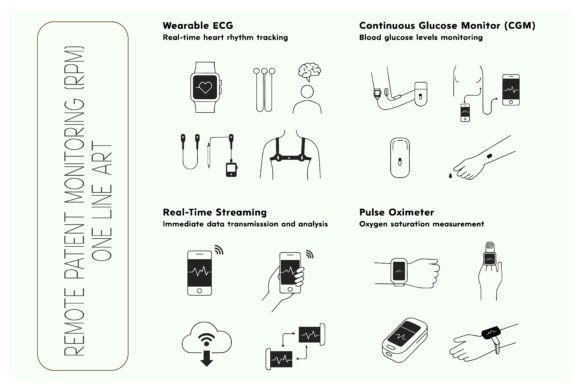
This is where minimalist line art vector sets—featuring wearable ECGs, CGMs, pulse oximeters, and real-time smartphone streaming—serve a practical purpose beyond aesthetics. They visually clarify how each component fits into the ecosystem: the device on the body, the data path to the cloud, the clinician’s review interface. Because they’re black-and-white outline illustrations, they avoid visual clutter while maintaining technical accuracy—ideal for brochures explaining setup steps, app onboarding screens guiding users through pairing, or infographics comparing data flow across different chronic conditions.
Strengths Across Real-World Use Cases
Remote Patient Monitoring RPM shines where early detection changes outcomes—and where frequent in-person visits create friction. For patients managing heart failure, daily weight and blood pressure tracking can predict decompensation days before hospitalization becomes necessary. In diabetes care, CGM data reveals patterns invisible to fingerstick checks: overnight hypoglycemia, post-meal spikes, or insulin timing mismatches. For COPD or post-operative recovery, pulse oximetry trends help assess oxygenation stability without repeated clinic trips.
These aren’t hypothetical benefits. Studies show Remote Patient Monitoring RPM reduces 30-day readmissions for heart failure by up to 35%, improves HbA1c control in type 2 diabetes, and increases patient engagement when paired with timely clinician feedback. But success hinges on fit—not every patient needs all sensors, and not every condition benefits equally from continuous streams. A stable hypertensive patient on fixed medication may gain little from daily BP uploads, whereas someone newly diagnosed with atrial fibrillation benefits significantly from rhythm documentation via wearable ECG.
Tradeoffs and Practical Limitations
No system works universally. Remote Patient Monitoring RPM requires reliable internet access, basic digital literacy, and willingness to wear or interact with devices daily. Older adults or those with dexterity challenges may struggle with sensor placement or app navigation—making intuitive design and caregiver support essential. Data volume also poses challenges: too many alerts without clinical context lead to alert fatigue; too few thresholds risk missing subtle deterioration. And while cloud analysis enables scalability, it depends on consistent data quality—if a pulse oximeter slips during sleep, gaps or artifacts can mislead interpretation.
There’s also a boundary question: Remote Patient Monitoring RPM supports management, not diagnosis. It doesn’t replace diagnostic ECGs, lab tests, or physical exams. It augments them—by extending observation windows and highlighting what warrants deeper investigation. Choosing Remote Patient Monitoring RPM means accepting that its value emerges over weeks and months, not minutes. It’s less about immediate answers and more about building longitudinal evidence to guide shared decisions.
When Remote Patient Monitoring RPM Is the Right Fit—And When It Isn’t
Remote Patient Monitoring RPM tends to align best when three conditions overlap: a measurable physiological parameter with known clinical significance (e.g., glucose, oxygen saturation, heart rhythm), a condition prone to silent progression or acute exacerbation, and a care team equipped to act on the data. Examples include post-discharge monitoring after cardiac surgery, titration of anticoagulants in atrial fibrillation, or supporting adolescents with type 1 diabetes transitioning to self-management.
It’s less suited for highly subjective symptoms—like chronic pain intensity or fatigue—unless paired with validated PRO (patient-reported outcome) tools. It’s also less effective without clinician buy-in: if alerts don’t trigger timely review or protocol-driven responses, the system adds burden without benefit. And for short-term, acute issues—like a 48-hour fever spike—episodic symptom logging may be simpler and more appropriate than deploying continuous hardware.
Consider alternatives thoughtfully. If the goal is behavior change—not physiological tracking—structured coaching apps with habit logging and motivational prompts may offer stronger engagement. If regulatory compliance or data sovereignty is paramount (e.g., in certain international or institutional settings), on-premise hosting options or HIPAA-compliant alternatives to cloud-first platforms become necessary considerations—not flaws in Remote Patient Monitoring RPM itself, but contextual factors shaping implementation.
Making an Informed Choice
Evaluating Remote Patient Monitoring RPM isn’t about selecting the most feature-rich platform or the flashiest wearable. It’s about matching capability to need: Which metrics matter most for this patient’s condition? Which devices integrate reliably with existing clinical systems? How will data inform—not delay—care decisions? Visual resources like medical technology line art vector sets help bridge understanding across stakeholders: developers use them to wireframe interfaces, clinicians reference them when explaining device use to patients, and educators embed them in training materials to demystify data flow.
Look for transparency—not just in marketing claims, but in clinical validation summaries, interoperability documentation, and support for real-world usability testing. Ask how alerts are triaged, how data gaps are handled, and whether patients can easily export or review their own historical trends. Remote Patient Monitoring RPM works best when it feels invisible in daily life—yet indispensable in clinical reasoning.