Aircraft Silhouette Vector SVG: Precision, Versatility, and Scalable Clarity for Aviation Visual Communication
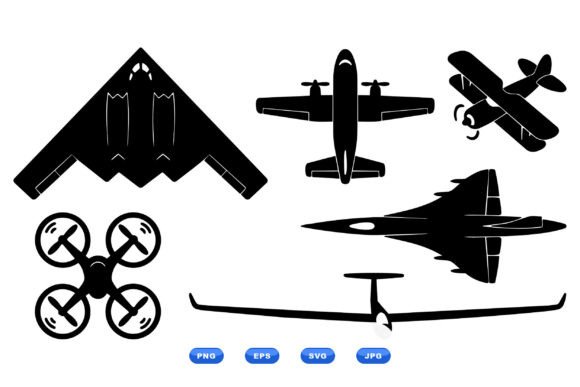
When visual clarity meets functional design in aviation contexts—whether in classroom instruction, airport signage, aerospace marketing, or maker-space fabrication—the Aircraft Silhouette Vector SVG emerges not as a mere graphic asset, but as a foundational communication tool. Unlike raster images constrained by resolution or stylized illustrations burdened by unnecessary detail, this collection delivers six top-down aircraft icons rendered in bold, minimalist vector form. Each icon is stripped to its essential geometric identity: clean contours, consistent stroke weight, and intentional negative space—all optimized for instant recognition at any scale.
Why Top-Down Aircraft Silhouettes Matter in Real-World Applications
Top-down (or plan-view) silhouettes serve a distinct cognitive purpose: they eliminate perspective distortion and emphasize spatial relationships. In air traffic control training materials, for example, instructors use such views to teach separation standards, runway occupancy logic, and taxiway navigation. Similarly, urban planners modeling drone delivery corridors or researchers mapping low-altitude airspace usage rely on unambiguous, orientation-consistent aircraft representations. The Aircraft Silhouette Vector SVG set supports these needs precisely because it avoids front-, side-, or 3/4-angle ambiguity—each icon presents a standardized, reproducible footprint.
This consistency extends beyond pedagogy. Wayfinding signage at general aviation airports often uses top-down silhouettes to denote hangar zones, fueling areas, or transient parking—where legibility at 50+ feet matters more than aerodynamic nuance. A pilot scanning a terminal diagram from the cockpit or a ground crew member reading a ramp operations manual benefits from symbols that require zero interpretation time. That’s the quiet power of minimalism done right: not simplicity for its own sake, but clarity engineered for human cognition under operational constraints.
Format Flexibility: From Digital Screens to Physical Fabrication
The delivered ZIP package includes three core formats—SVG, EPS, and PNG—and a JPG preview—each serving complementary roles across workflows:
- SVG (Scalable Vector Graphics): The native web format. Embed directly into HTML, animate with CSS or JavaScript, style strokes and fills dynamically, and retain razor-sharp rendering on retina displays or projectors. Ideal for interactive aviation dashboards, responsive educational websites, or digital flight simulators needing lightweight, scriptable assets.
- EPS (Encapsulated PostScript): Industry-standard for professional print production. Compatible with Adobe Illustrator, CorelDRAW, and prepress workflows. Ensures precise color separation, CMYK fidelity, and crisp output on large-format banners, vinyl decals, or regulatory signage requiring Pantone-matched accuracy.
- PNG (Transparent Background): Pixel-perfect for layered digital compositing—think PowerPoint safety briefings overlaid on satellite imagery, social media infographics with gradient backgrounds, or mobile app UIs where icons sit atop dynamic content. Its alpha channel preserves hard edges without anti-aliasing artifacts common in JPG exports.
The inclusion of a standard JPG preview isn’t merely convenience—it’s a practical checkpoint. Designers can quickly assess proportion, spacing, and stylistic cohesion before opening vector editors. For educators building slide decks in Google Slides or Microsoft Teams, that JPG often becomes the first point of integration—then replaced later with SVG for accessibility and scaling integrity.
Real-World Implementation Across Diverse User Groups
Different users extract different value from the same underlying asset. Consider how each cohort applies the Aircraft Silhouette Vector SVG:
Educators and Curriculum Developers
In STEM classrooms, these silhouettes appear in physics lessons on lift-to-drag ratios (comparing wing aspect ratios across aircraft types), geography units mapping global air routes, or coding exercises where students drag-and-drop icons to simulate fleet deployment. Because the vectors are editable, teachers can recolor aircraft by engine type (turbofan vs. turboprop), annotate control surfaces, or isolate landing gear configurations—all without licensing restrictions or pixel degradation.
Aviation Branding Professionals
Marketing teams launching a new flight school, charter service, or UAV inspection platform need cohesive visual language. These six icons provide immediate typographic harmony when paired with sans-serif fonts like Inter or Montserrat. One client used the jet silhouette as a bullet point in a service comparison table; another embedded the helicopter variant into a custom favicon and email signature—both leveraging the same source file. No re-tracing. No vendor dependency. Just consistent, brand-aligned recognition.
Makers and Small-Batch Producers
For Cricut and Silhouette users, the SVG’s path-based structure ensures clean cut lines—no jagged edges or nested clipping masks that confuse cutting software. A hobbyist crafting wooden aircraft coasters resized the propeller plane icon to 8 inches, then exported a DXF version (easily derived from SVG) for laser engraving. Another printed peel-and-stick decals for RC plane fuselages using the transparent PNG, aligning perfectly with curved surfaces thanks to its vector-derived proportions. The key enabler? Editability without compromise: stroke width, corner radius, and anchor points remain fully manipulable in any vector editor.
Regulatory and Safety Communicators
Organizations like EASA, FAA advisory circulars, or airport emergency response manuals prioritize universal comprehension over aesthetic flair. Bold, high-contrast silhouettes reduce translation overhead and support multilingual audiences. When illustrating “no-fly zones” around stadiums or critical infrastructure, pairing a red circle with one of these aircraft icons conveys prohibition faster than text—especially under time-sensitive conditions. That functional immediacy stems directly from the minimalist discipline embedded in each Aircraft Silhouette Vector SVG.
Technical Considerations for Optimal Use
While the asset is designed for broad compatibility, thoughtful implementation enhances longevity and performance:
- Color Accessibility: The base black-on-transparent palette passes WCAG 2.1 AA contrast thresholds against light and dark backgrounds—but avoid relying solely on color to differentiate aircraft types. Pair hues with distinct shapes (e.g., twin-tail vs. single vertical stabilizer) for users with color vision deficiencies.
- Responsive Sizing: In web contexts, declare
viewBoxattributes explicitly when embedding SVGs inline. This preserves aspect ratio across devices and prevents unintended stretching on mobile viewports. - File Optimization: Before deploying SVGs in production, run them through tools like SVGO to remove metadata, redundant groups, and unused IDs. A typical icon drops from ~8 KB to under 2 KB—critical for fast-loading aviation training portals with dozens of embedded assets.
- Print Bleed and Trim: When preparing EPS files for physical signage, extend artwork 1/8 inch beyond trim edges and embed fonts if text labels are added. Most vector editors handle this via “document setup” or “export for print” presets.
Looking Beyond the Icon: Toward Contextual Integration
An Aircraft Silhouette Vector SVG gains meaning only in context. A single jet icon on a blank page communicates little. But place it within a labeled schematic of terminal maneuvering areas, pair it with altitude-coded flight levels in an infographic, or animate it along a georeferenced flight path on a map—and it becomes a node in a larger system of understanding. That’s why the most effective users treat these icons not as decorative flourishes, but as modular components in scalable visual systems.
One university aviation department built a reusable Figma library where each aircraft silhouette links to a shared component set: hover states show technical specs, click-throughs open related FAA documents, and variants toggle between IFR/VFR configurations. Another municipal drone task force created an internal wiki where every regulation references the relevant aircraft type via these icons—creating visual anchors across policy, training, and enforcement documentation.
This level of integration doesn’t require advanced coding. It starts with recognizing that scalability isn’t just about resolution—it’s about semantic flexibility. The Aircraft Silhouette Vector SVG provides the raw material; context provides the meaning. And meaning, in aviation communication, is never incidental—it’s engineered, verified, and mission-critical.
Final Thought: Utility Over Ornamentation
In an era saturated with AI-generated visuals and over-designed templates, the enduring value of a well-crafted Aircraft Silhouette Vector SVG lies in its refusal to distract. It doesn’t mimic photorealism. It doesn’t chase trends. It answers a precise question: “How do we represent this aircraft type, instantly and accurately, across every medium we use?” That singular focus—on utility, interoperability, and human-centered legibility—is what transforms a simple download into a durable, cross-disciplinary resource. Whether etched onto aluminum signage at a regional airport or animated in a student’s Python-powered airspace simulator, its function remains constant: to clarify, not complicate; to enable, not embellish.